March 4, 2026
Building a Smarter Fabrication Shop: Integrating the Automation from the Ground Up
Interview with Eddie Gasbarri — Director of Fabrication, Fablogix, Duncan, South Carolina, USA.
Designing for a New Era of Fabrication
The pressure on fabrication shops to deliver higher productivity, consistent quality, and full data traceability has never been greater. As demand for pipe spools and process piping continues to grow across industrial and commercial sectors, contractors face two persistent challenges: a shortage of skilled welders and the need for more predictable delivery timelines.
Automation has therefore shifted from being a novelty to a necessity. Fablogix, a 150,000-ft² fabrication facility located near Duncan, South Carolina, set out to demonstrate what can be achieved when a shop is designed around automated welding from the very beginning.
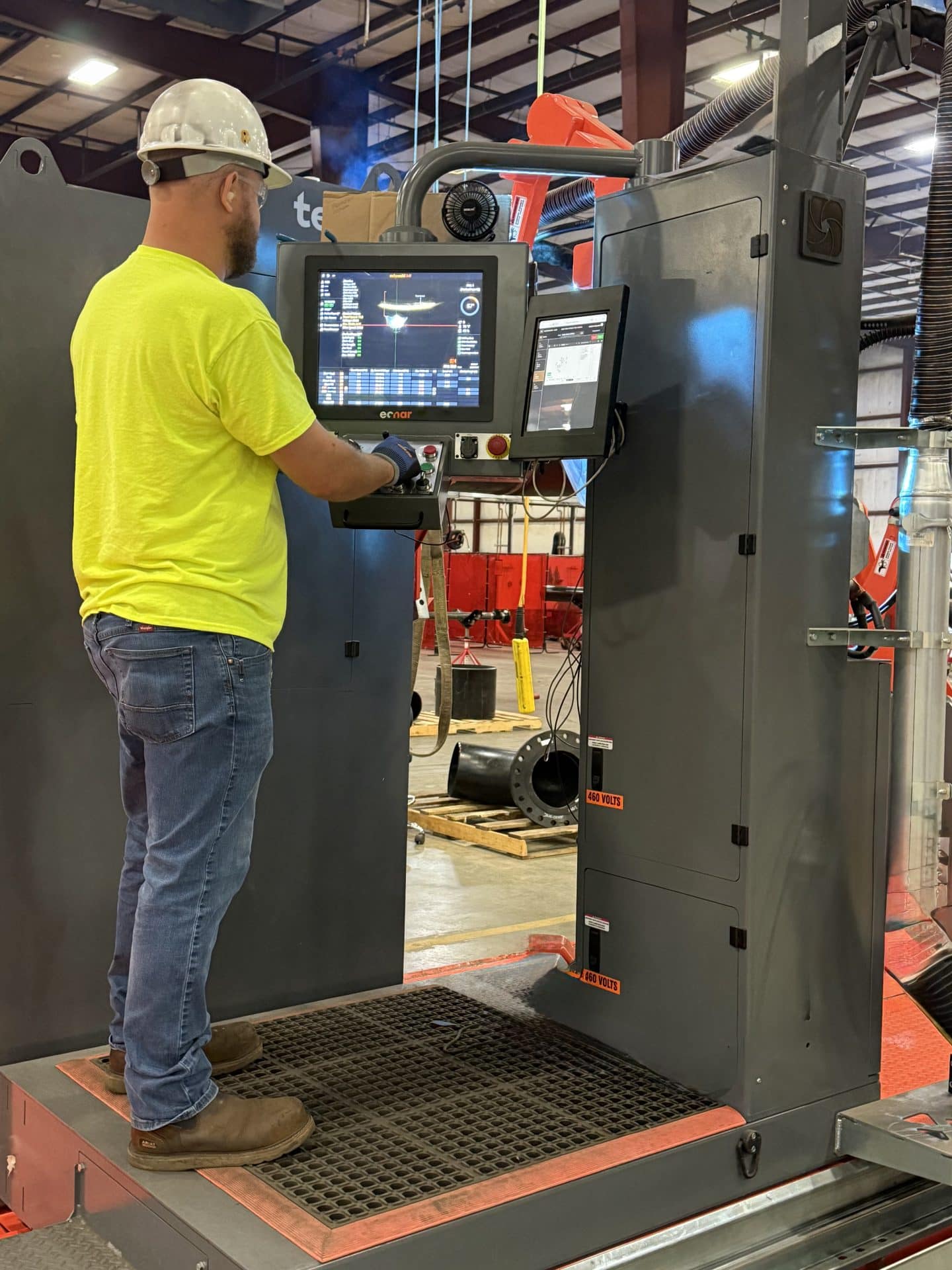
Fablogix integrated the Rotoweld 3.0, a fully automated pipe-spool welding system powered by PerfectPass-iQ welding intelligence, together with its digital quality-assurance tools to increase throughput, improve repeatability, and redefine workforce roles within a modern fabrication environment.
Building a Shop Around Automation
When Fablogix opened its doors in early 2025, it was already part of a larger construction ecosystem. Backed by Kelso Industries, which owns more than two dozen mechanical, electrical, and plumbing firms, the shop was conceived to provide in-house control over quality, scheduling, and costs.
From the outset, Director of Fabrication Eddie Gasbarri decided that the Rotoweld 3.0 would form the cornerstone of the operation. Rather than retrofitting automation into an existing layout, the facility was purpose-built to accommodate Rotoweld 3.0 cells, optimized fit-up tables, and smooth material flow.
“It’s easier to plan a shop around automation than to adapt later,” Gasbarri explains. “We designed everything—from booth layout to staffing levels—with machine efficiency and operator visibility in mind.”
The result is a streamlined production floor with 24 welding booths and 20 fit-up stations. The shop currently employs 50 people and expects to triple that number within the next few years.
Rotoweld 3.0 — Adaptive Welding Intelligence in Practice
At the heart of Fablogix’s production line is the Rotoweld 3.0, which combines robotic motion control with real-time weld-pool monitoring. Its built-in adaptive intelligence, known as PerfectPass-iQ, continuously adjusts welding parameters as conditions change, maintaining consistent penetration, bead shape, and quality even when joint gaps vary.
This closed-loop feedback approach reduces the dependency on operator parameter tuning, allowing consistent results across shifts and operators.
“Even experienced welders get excited when they see it work,” Gasbarri says. “It removes fatigue and repetition from the job. Our team can focus on higher-complexity welds while the Rotoweld 3.0 handles the repetitive passes.”
Training new operators has also proven remarkably fast. According to Fablogix, workers with limited welding backgrounds reach production competency within two weeks. One operator, previously a carpenter, commented that “the machine feels like it’s helping you succeed—it’s smart and forgiving.”
Fit-Up Precision and Process Discipline
Automated welding requires more consistent fit-ups than manual methods, a challenge Fablogix embraced. Tighter fit-up standards demand improved cutting accuracy, pipe preparation, and alignment, but they also deliver higher final quality and fewer reworks.
“Manual welding allows more improvisation,” Gasbarri explains, “but that often hides inconsistencies. With the Rotoweld 3.0, the process forces us to improve upstream operations—fit-up, bevels, alignment. It’s made us more disciplined.”
By maintaining stricter tolerances, Fablogix enables the Rotoweld 3.0 and its PerfectPass-iQ control to produce clean, repeatable welds with minimal spatter and distortion, yielding better dimensional accuracy and reliability over both day and night shifts.
Quantifying the Impact — Productivity and Quality
The combination of precision fit-up, adaptive control, and optimized workflow has produced measurable results. Since commissioning its first Rotoweld 3.0 cell, Fablogix has reported up to an eight-fold increase in production throughput compared to traditional manual welding.
This improvement reflects not only higher welding speed but also reduced downtime, consistent arc-on time, and fewer reworks. The Rotoweld 3.0’s ability to maintain weld quality from the first joint to the last enables Fablogix to confidently run two full production shifts with predictable output.
“When we prepare a bid, we know exactly how long a job will take,” Gasbarri notes. “That level of certainty gives us an advantage in both scheduling and client confidence.”
Digital Quality Assurance and Traceability
Every weld performed with the Rotoweld 3.0 is tracked and recorded through Prodatalog, a digital production-monitoring platform integrated into the system. It automatically logs parameters, operator ID, and weld completion data, providing end-to-end traceability—an increasingly critical requirement for large industrial clients.
Supervisors can visualize weld trends, consumable use, and arc-time performance, identifying deviations before they impact quality. This data-driven visibility also supports preventive maintenance. “We can look at historical data to spot small changes that might indicate equipment wear,” Gasbarri explains. “That keeps our uptime high and our weld quality consistent.”
Training and Workforce Evolution
One of the most striking results of Fablogix’s automation journey has been the cultural shift among welders. Rather than replacing skilled workers, the Rotoweld 3.0 has redefined their roles. Experienced welders now focus on complex welds, quality control, and mentoring new operators.
“It’s not about removing the trade—it’s about evolving it,” Gasbarri emphasizes. “Automation creates more opportunities for people who enjoy technology and precision.”
The Rotoweld 3.0’s intuitive interface attracts a new generation of technicians who might not come from a traditional welding background but have strong technical aptitude. The collaboration between seasoned welders and tech-savvy operators fosters continuous improvement and knowledge sharing across shifts.
Support and Continuous Improvement
Implementing an automated system of this scale requires both technical expertise and sustained support. Fablogix’s commissioning of the Rotoweld 3.0 was guided by close collaboration between its internal engineering team and Tecnar’s service specialists.
That partnership continues through ongoing software updates, process optimization, and operator feedback. “Having responsive technical support makes a big difference,” Gasbarri says. “It gives us confidence to keep pushing the technology further.”
Conclusion — Lessons for the Welding Industry
Fablogix’s experience shows what can be achieved when a fabrication facility is designed around the Rotoweld 3.0 and automation principles from the outset. By integrating adaptive process control, digital QA, and data-driven management, the company has realized significant gains in productivity, weld quality, and workforce flexibility.
For the wider welding industry, this case study illustrates that automation is not about replacing human skill but amplifying it. As labor shortages persist and quality expectations rise, intelligent systems like the Rotoweld 3.0—paired with data transparency and skilled supervision—offer a sustainable path forward for pipe-fabrication excellence.